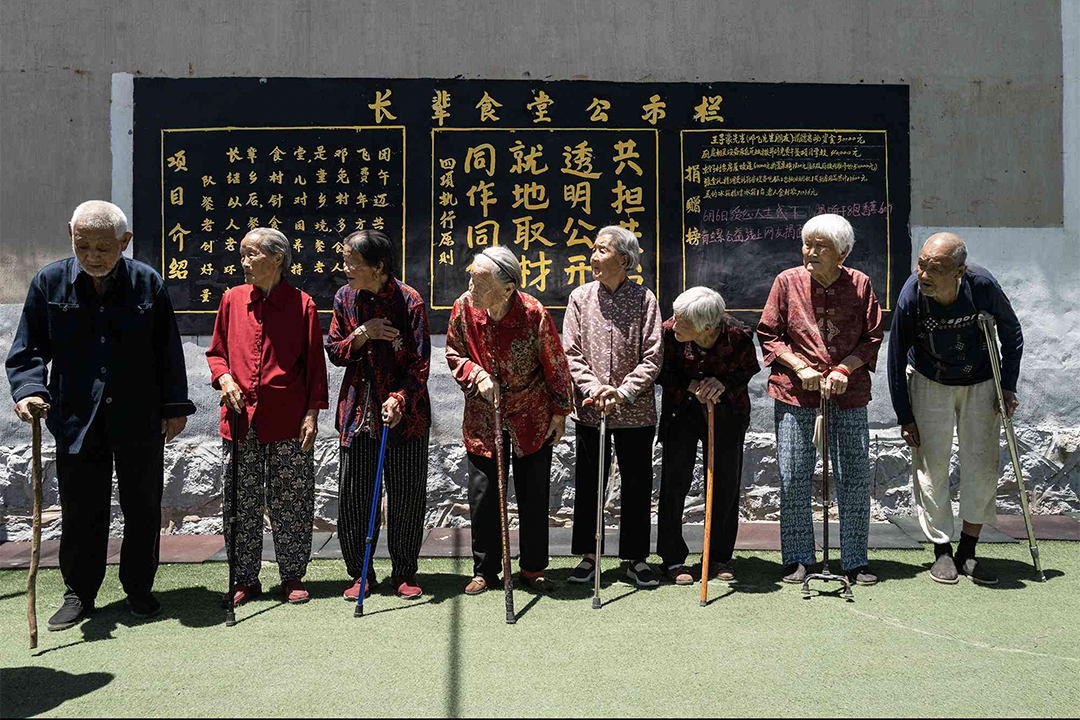
Villagers over 80-years-old wait for a free meal at a senior canteen converted from an old elementary school in Dongtangzi village, Shandong province on June 7, 2026. Photo: Zheng Haipeng /Caixin
Every day at 11 a.m. sharp, 93-year-old Fang Rongying sets out for lunch. She has bound feet, a hunched back, and leans on a cane. The walk to the seniors’ dining hall is barely 500 meters (1,640 feet), but it takes her more than half an hour. She stops to rest along the way, then carries on — hobbling toward a hot meal that many of the other village senior citizens still cannot quite believe is free.
After her husband and then her 62-year-old son died, Fang was left alone. Her grandson installed cameras both inside and outside her home so the family could check on her. She said that she wanted company but was afraid of being a burden.
At the dining hall, she usually is the last to leave. She laughs about the size of her appetite: a bowl of stir-fried vegetables and three steamed buns in a sitting.
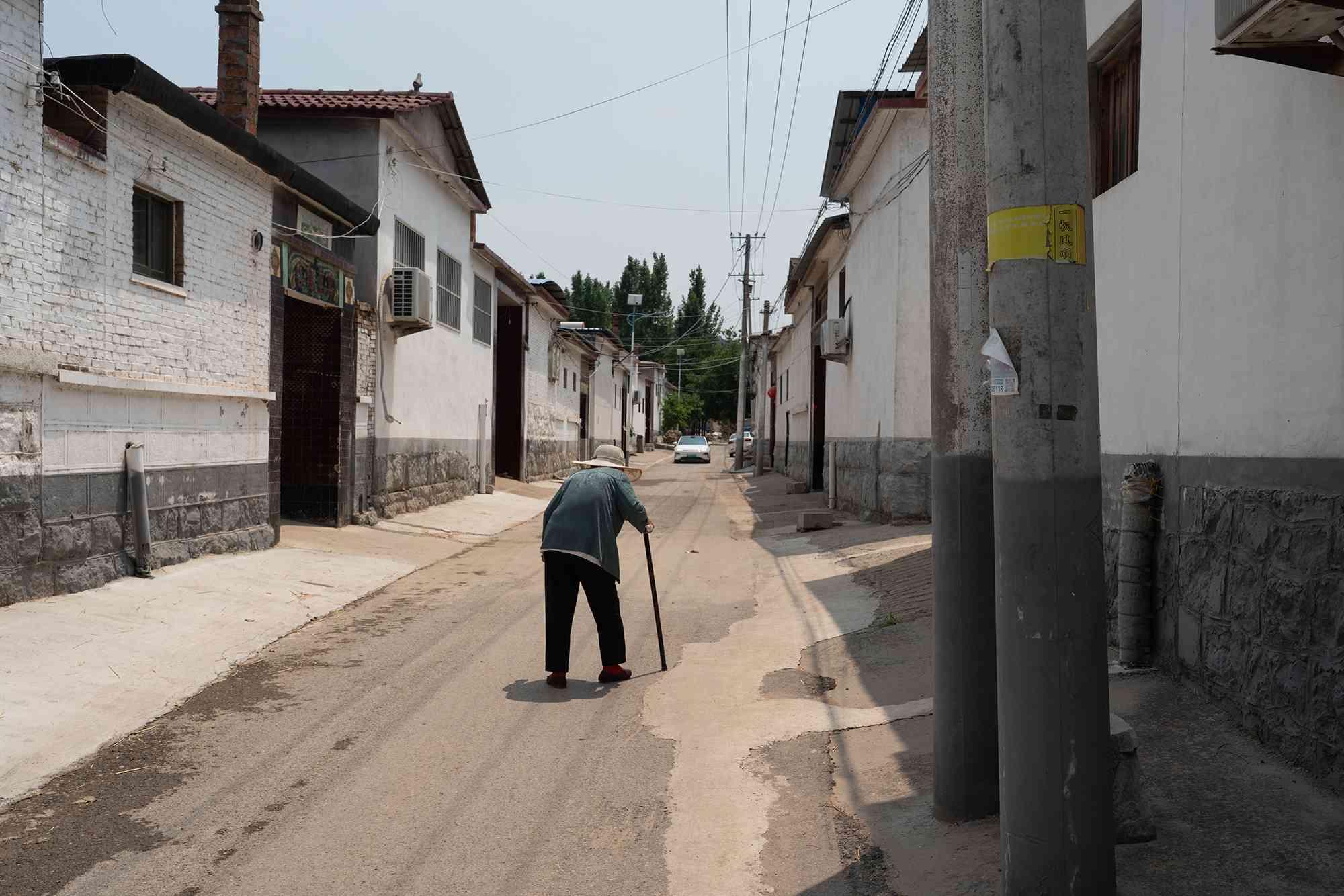
Fang Rongying, 93, walks through Dongtangzi village in Shandong province’s Dongping county. The five-minute walk from her home in the village to the seniors’ dining hall takes her half an hour. Photo: Zheng Haipeng/Caixin
For Fang, along with many other senior citizens in her village — where nearly half the population is over 60 — the free meal is an “experiment” that has been running for a year and a half.
In Dongtangzi village in Shandong province’s Dongping county, many of the young people have long since left for work elsewhere, draining the village down to the old and the very young. Every weekday at lunchtime, the experiment plays out the same way: a hot, nutritious meal for the village’s oldest residents, served from a dining hall built inside a school that no longer has any children to teach.
Senior benefits
Wang Yunzhong, 86, and his wife, 83-year-old Ma Jilan, are regulars too. Frail and unsteady after several falls, Wang walks with a crutch. Their trip of a few hundred meters also takes half an hour.
At first, most of the seniors could not believe the lunch was really free. A year and a half on, the dining hall runs smoothly. At each mealtime, more than 40 people make their way in from across the village. Anyone 80 or older eats for free, receiving a meat dish, a vegetable dish, rice soup and steamed buns. Those under 80 can join for a small fee, but few do.
The food is simple, but for the octogenarians it amounts to the best meal of their day. “Not bad” is the phrase they reach for most. Eating here last year, Wang gained 5 kilograms (11 pounds). A later fall kept him home for a long stretch and he lost the weight again. When his health came back, he returned to the dining hall and put away five meat buns in one visit.
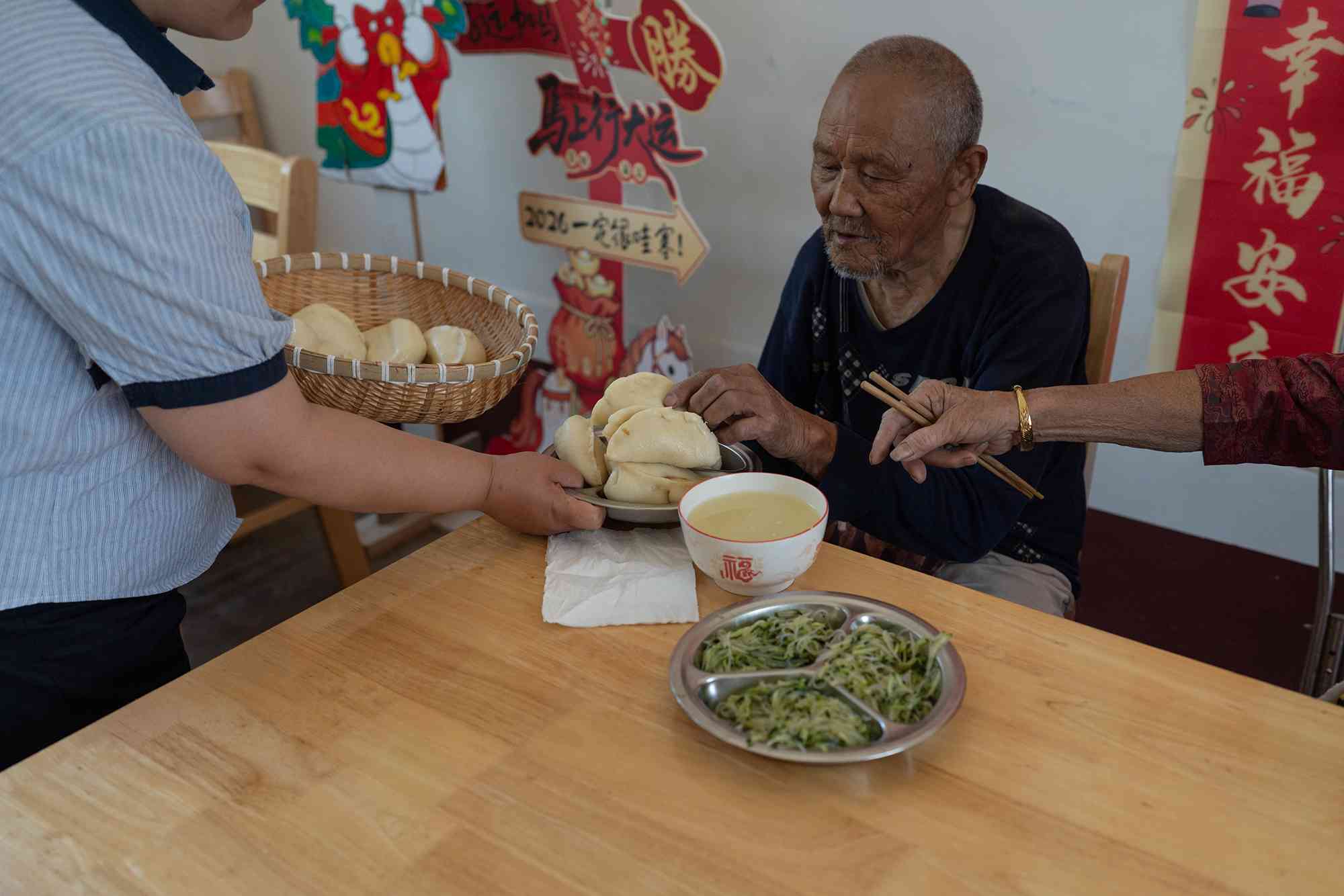
After a fall kept him home for a spell, Wang Yunzhong returns to the dining hall, where he put away five meat buns. Photo: Zheng Haipeng/Caixin
For 88-year-old Fang Juying the dining hall food is better than what she makes at home. Cooking for herself, she is reluctant even to use oil, she said. What pleases her most is the company. The village is small, but its seniors rarely gathered together. Now they linger on the steps and at the tables, talking before and after the meal.
Because the food costs them nothing, some eat with new enthusiasm, like Wang and his five buns. Others have a more practical take: eat a full lunch, and the evening needs only a bowl of cornmeal porridge or egg soup.
‘Not eating well’
Away from the dining hall, daily meals in the village are spare. Morning and evening, a bowl of porridge or egg soup often suffices. At midday, it’s a steamed bun or a bowl of noodles. 81-year-old Wang Qingxiang said she could no longer lift an iron pot, let alone cook a proper meal. Sometimes, she goes a day or two on one meal.
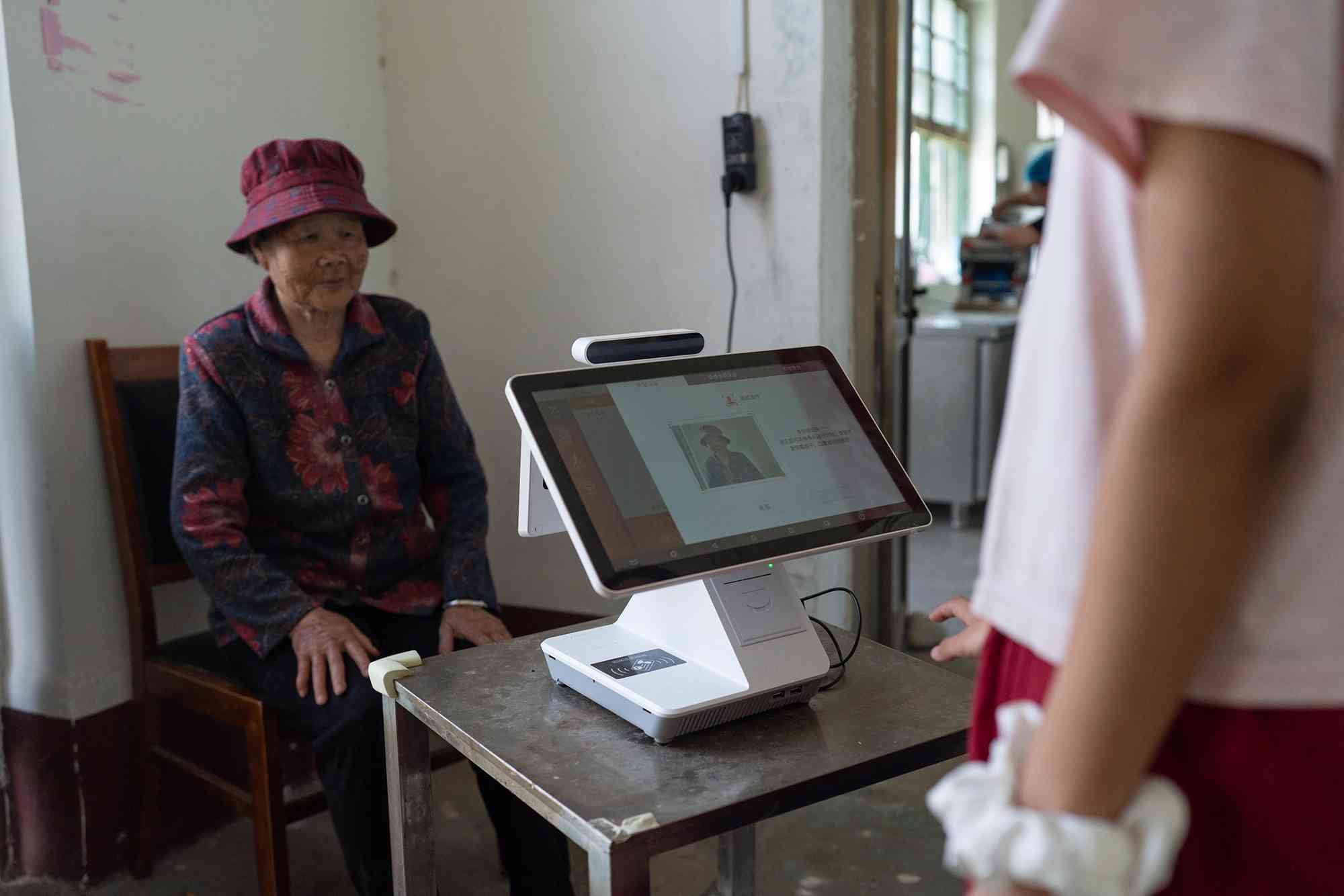
Before lunch, a staff member helps 81-year-old Wang Qingxiang log her meal registration information. Photo: Zheng Haipeng/Caixin
Ma Jilan rarely buys meat or vegetables. She eats porridge morning and night and boils dried noodles at noon, making do with pickled vegetables. Five yuan of steamed buns, frozen, lasts two or three days. Her refrigerator’s cool compartment holds two bowls of pickles and a handful of garlic, but little else. She and Wang receive 436 yuan ($64.40) a month in pension between them — just enough for daily life. “As long as we don’t get sick,” she said, “300 yuan a month is enough.” The rest they set aside, in case of illness.
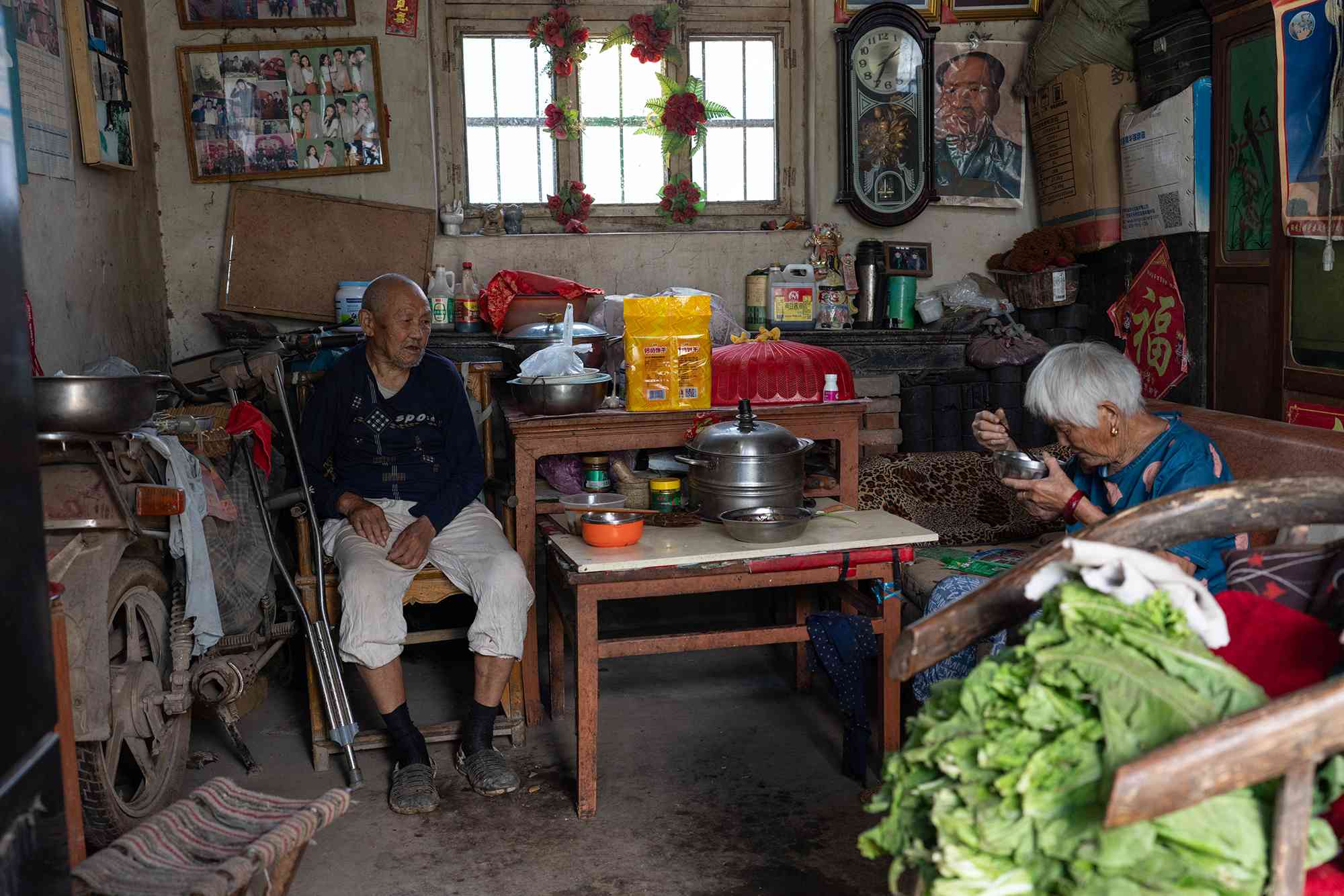
With the roads still wet from the rain, 86-year-old Wang Yunzhong and 83-year-old Ma Jilan make a simple meal of noodles at home. Photo: Zheng Haipeng/Caixin
Zhang Jinfeng, an elementary school teacher and the dining hall’s founder, has visited the seniors’ homes many times over the years. The crisis in the countryside, she has come to believe, is no longer that the old have nothing to eat. It is a quieter problem. “They can eat, but they’re not eating well,” she said.
Calcium, sodium and potassium deficiencies are common, she said, and it is worst among the oldest, the infirm and those living alone.
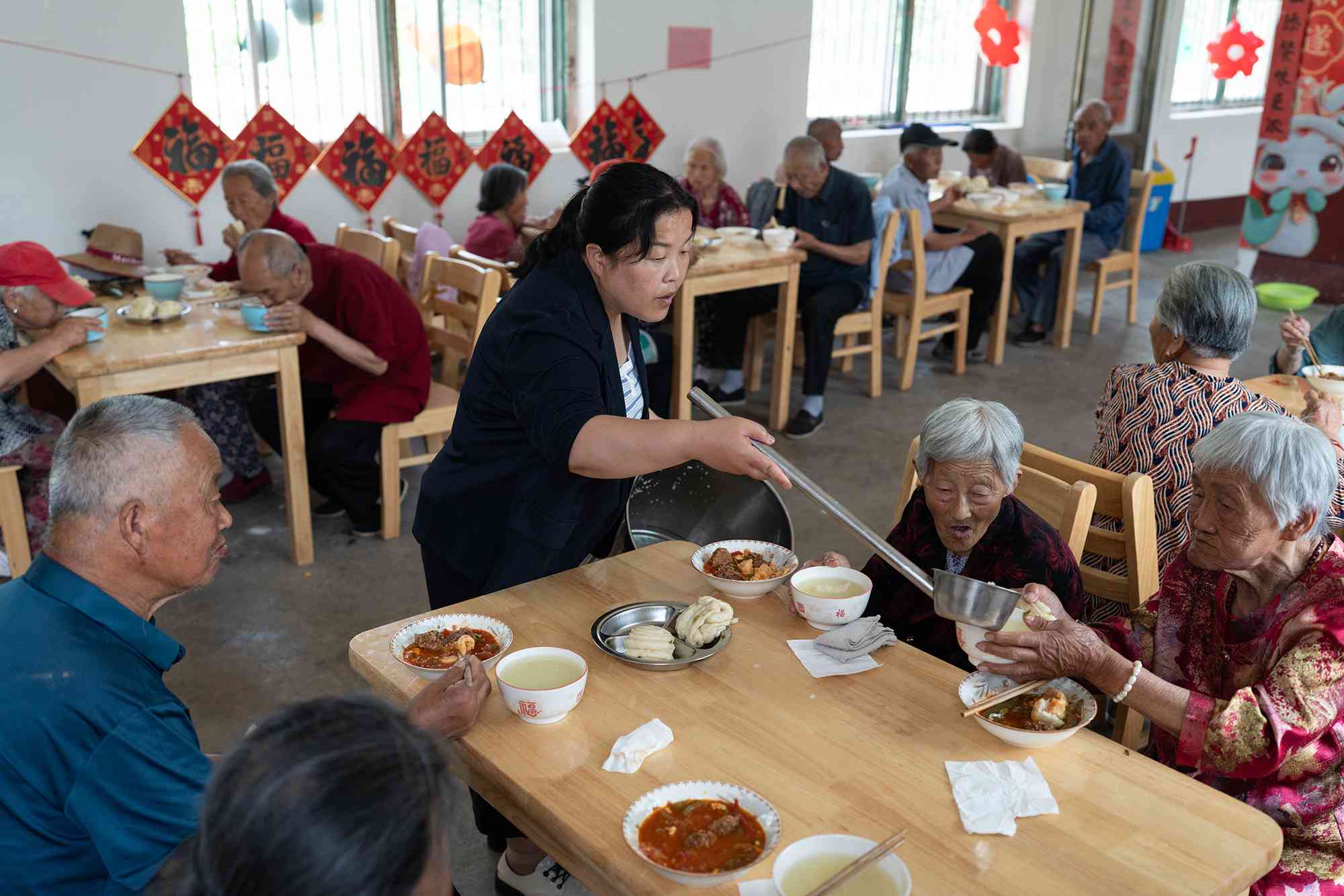
Zhang Jinfeng, who started the dining hall, serves porridge to seniors. The dining hall’s daily menu includes one meat dish, one vegetable dish, one soup and rice. Photo: Zheng Haipeng/Caixin
Eating too little eggs, meat and milk, along with a reluctance to cook for one can flatten the diet to almost nothing. That is exactly what makes a single hot, varied meal matter so much.
Empty nests
The dining hall sits on the site of the old Dongtangzi Elementary School, closed in 2010 and later turned into a kindergarten, Zhang said. She once linked the kindergarten to the free lunch charity, which fed the children a balanced midday meal.
Then the children, too, went away. A former teacher, Wang Yingying, remembers 30 or 40 pupils when she arrived in 2019. But by the time the kindergarten closed in the summer of 2022, only about 10 were left, she said.
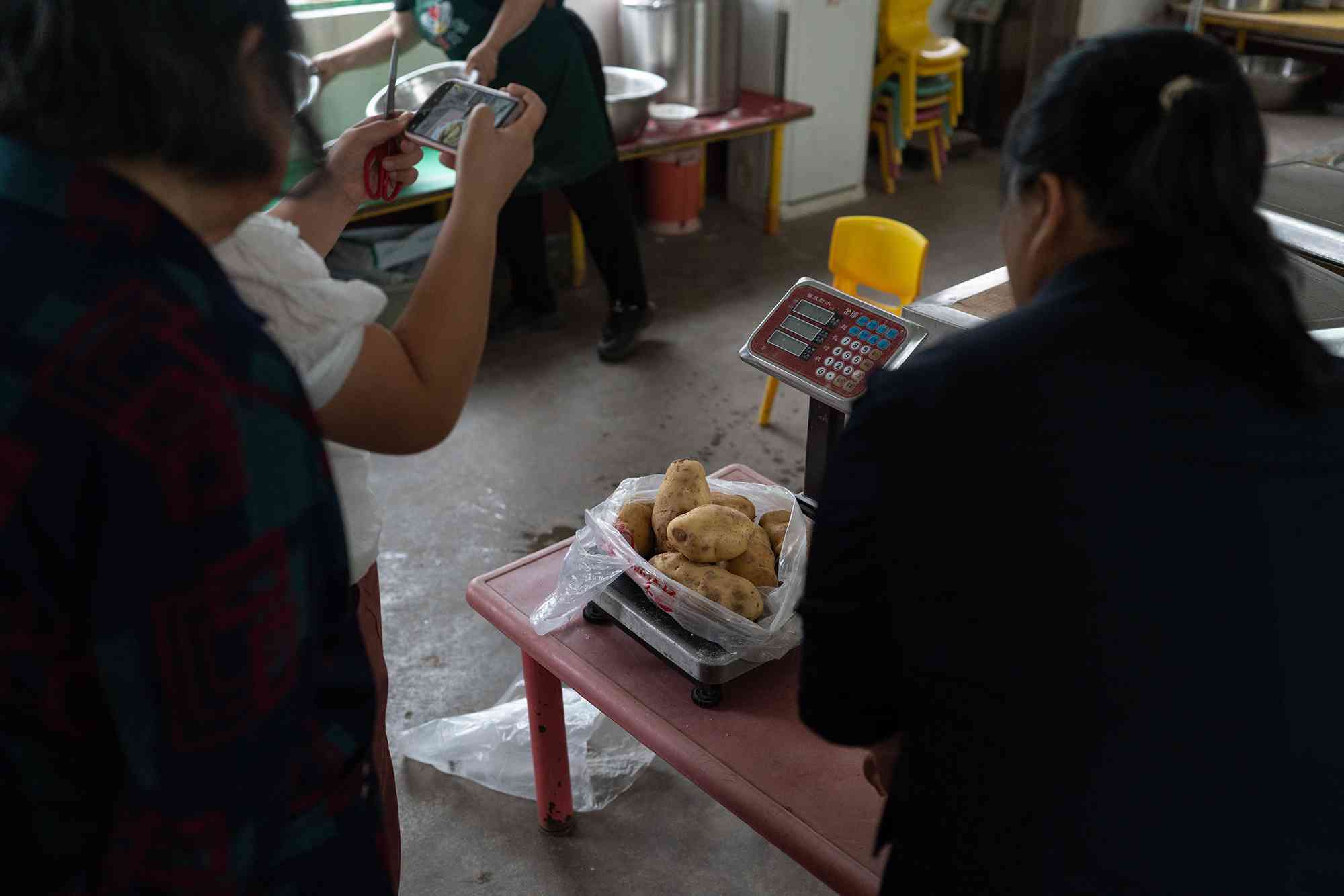
Staff member Wang Yingying weighs and takes photos of the vegetables as part of the dining hall’s regular public disclosure. Photo: Zheng Haipeng/Caixin
The campus sat empty until 2024, when it became the first seniors’ dining hall in the county. The same kitchen equipment that once cooked free lunches for children now cooks for the village’s oldest members.
The arithmetic of the place had inverted. A village that once worried about its young now counts its old. Of the roughly 780 permanent residents, about 372 are over 60, and 69 are over 80, according the local party secretary.
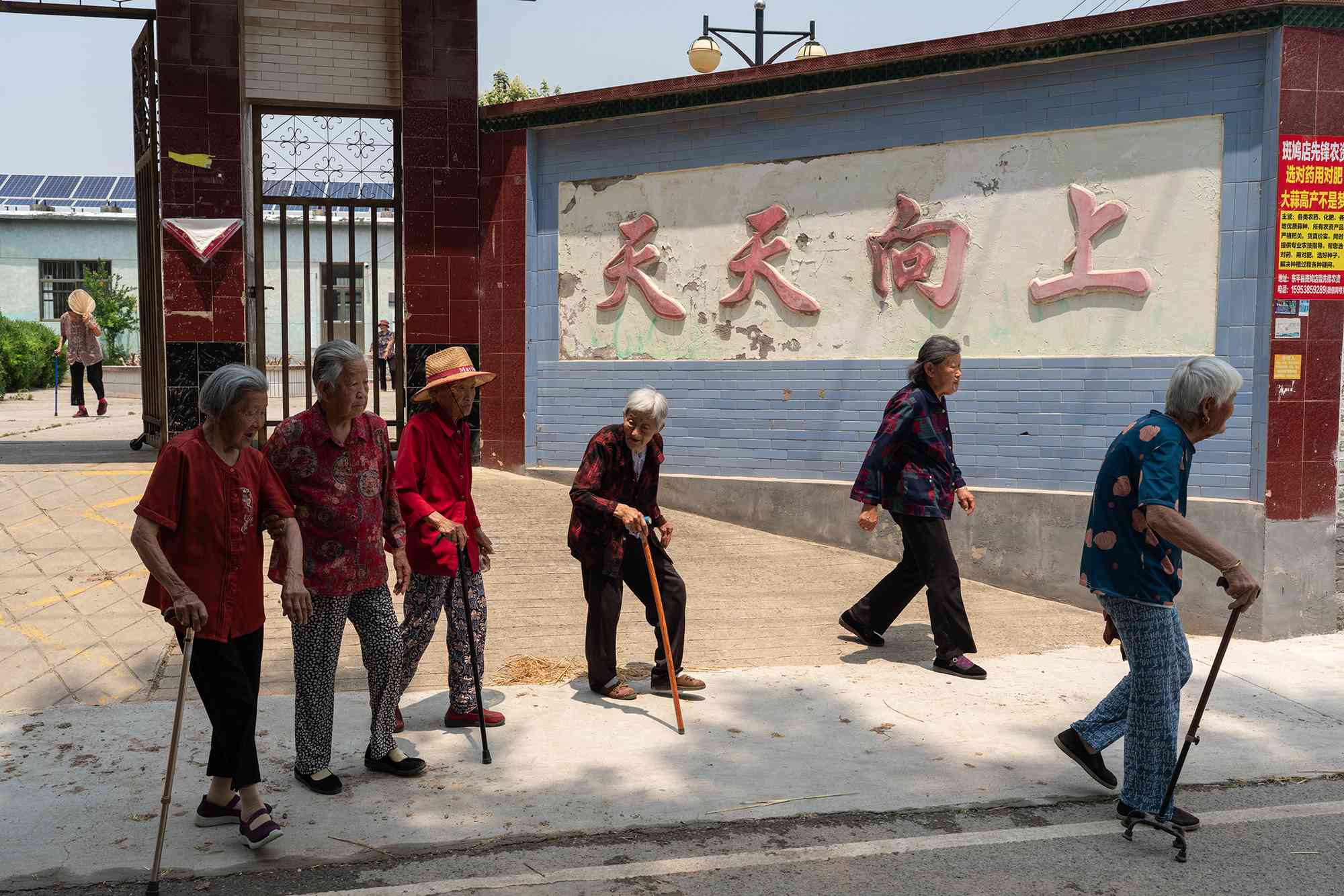
After the meal, seniors file out of the dining hall. Photo: Zheng Haipeng/Caixin
Young people have been leaving Dongtangzi to work elsewhere, upsetting the traditional model in which adult children care for aging parents under one roof. What is left behind is a large number of empty nest seniors.
With the backing of the village’s former leader, the dining hall — started by a charity in wealthy Zhejiang province together with a foundation — opened in Dongtangzi in October 2024. It was meant to be more than a kitchen. It was supposed to be a hub for senior care, offering company and a bit of recreation alongside the food. Zhang had pitched the idea to eight villages, but most were not ready.
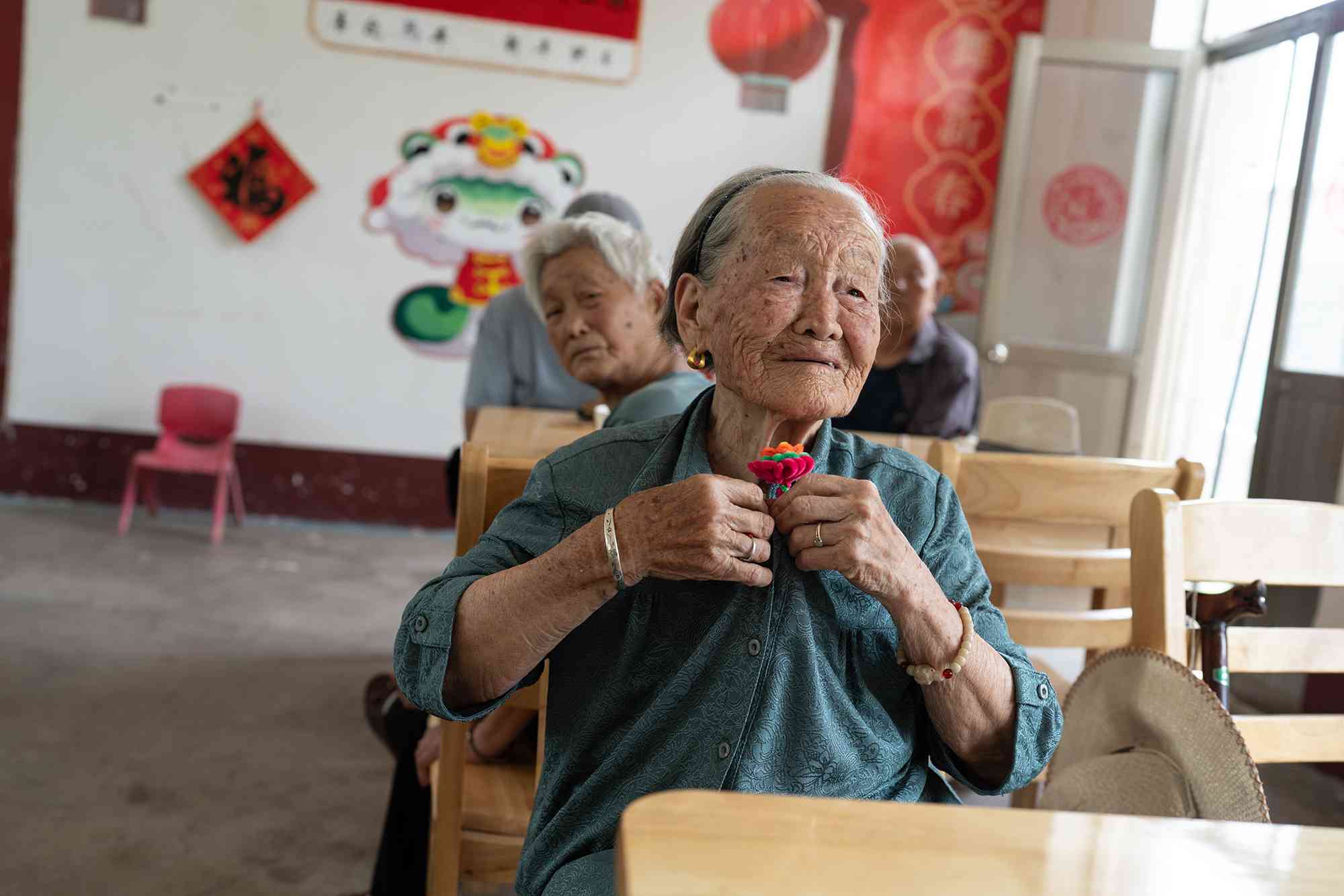
93-year-old Fang Rongying pins a folded handmade paper flower to her chest. Photo: Zheng Haipeng/Caixin
Holding on to optimism
Zhang set the meal standard at 6 yuan a day per person. With donated rice, flour and oil, the real cost of a meal runs to about 1.8 yuan. Roughly 80 percent of supplies come from donations — bags of flour and vegetables from neighbors, hundreds of pounds of eggs from further afield.
The county civil-affairs bureau provides an operating subsidy tied to how many meals are served. In 2025 the dining hall served 19,000 and received 40,000 yuan, according to Zhang. By her reckoning, it takes about 70,000 yuan a year to keep it running. It’s enough for food for some 50 seniors, staff wages and daily expenses.
To stretch the budget, one side of the yard was turned into a vegetable garden, planted by the seniors themselves. In the summer, with donated staples and home-grown greens, the dining hall feeds more than 40 people on less than 100 yuan a day. Every morning the day’s purchases and donations are posted in a chat group and chalked onto a blackboard outside, where villagers gather to check the figures — an effort to keep the project open and suspicions at bay.
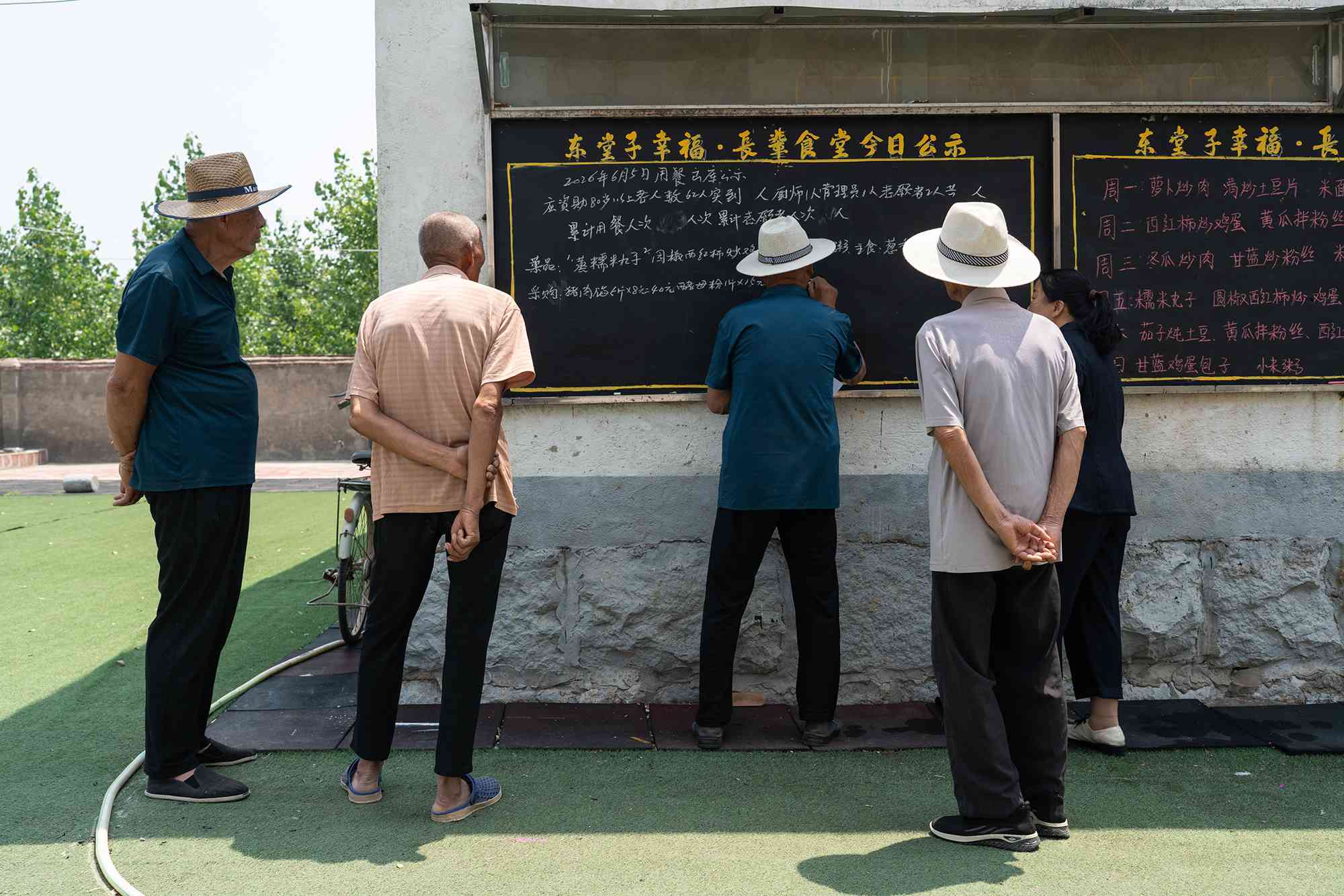
86-year-old Chen Renke writes down the dining hall’s inventory records and meal expenses on a blackboard, as villagers gather around. Photo: Zheng Haipeng/Caixin
Still, uncertainty weighs on the people running things. Dongtangzi’s party secretary, Wang Jianan, noted that renovating the empty school cost 60,000 yuan, with another roughly 7,000 yuan spent on tables and chairs. In addition, the village now spends nearly 1,000 yuan a month to cover electricity and garbage collection costs. “Our village has no industry,” he said. “Before, the village account had over 100,000 yuan. Now that the dining hall’s open, it’s gone straight into deficit.”
Yet he stands by it. The dining hall has become the village’s calling card, and on his watch he means to keep it going. “If it fails under me, the villagers will poke me in the spine.”
In a neighboring village, party secretary Pang Hongbo opened the county’s second seniors’ dining hall, but is less optimistic, expecting donations to fade and the burden to fall on villages that cannot easily carry it.
Zhang stays optimistic. A bit from the government, a bit from the collective, a bit from companies, a bit from society, a bit from individuals — it’s enough, she believes, to keep the doors open. But she is clear-eyed about one thing: the seniors’ dining hall draws far less attention than the free lunch for schoolchildren ever did. There is a bias, she said, toward “raising the young but not the old.”
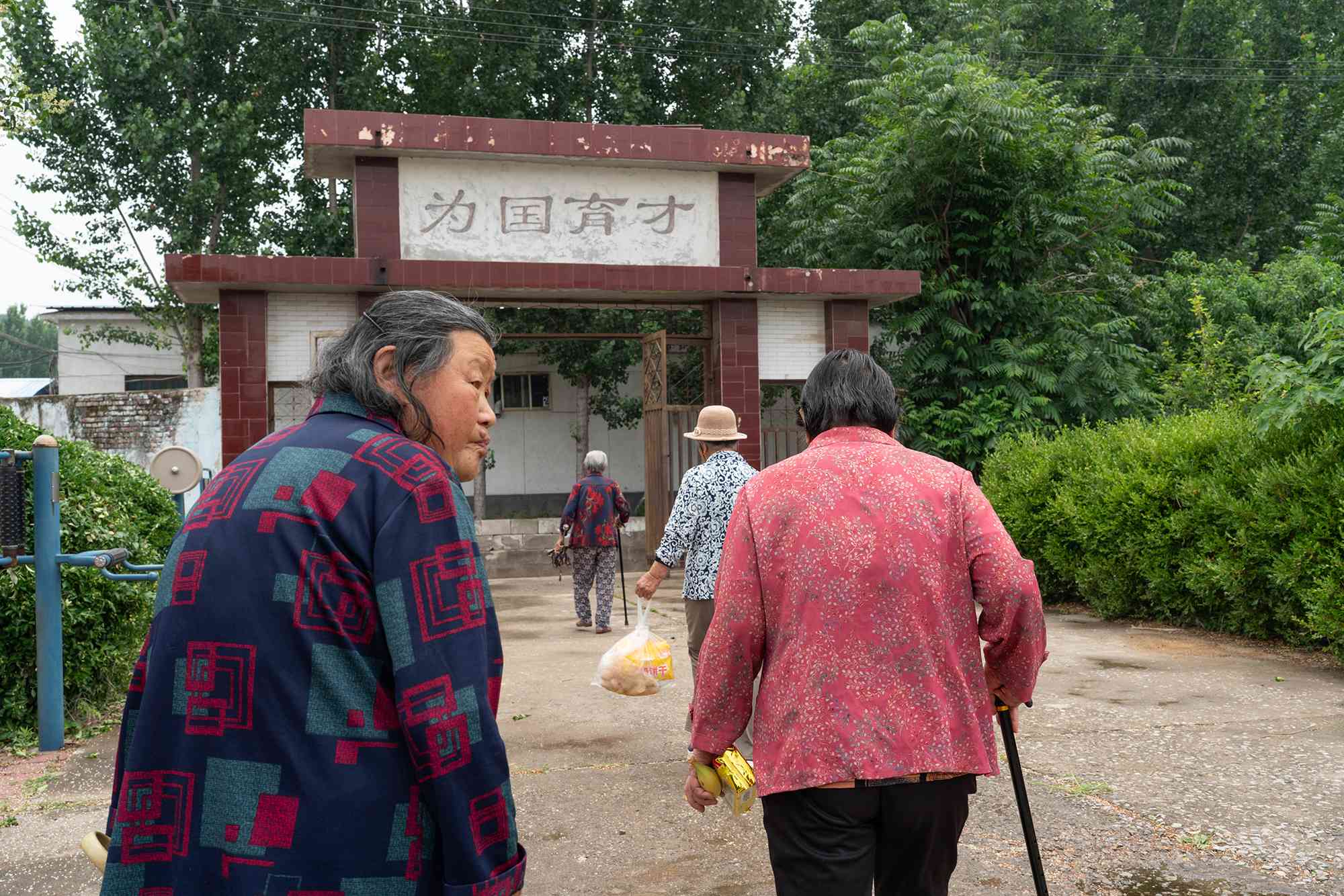
After the meal, the seniors leave the dining hall. The gate of the former elementary school still bears the slogan: “Cultivating talent for the nation.” Photo: Zheng Haipeng/Caixin
By the count of Xu Mei, the village women’s director for more than 30 years, 20 more local residents will turn 80 over the next two years. “The day after they pass their 80th birthday,” she said, “we will tell them to come for free meals.” But Zhang estimates that current supplies and funds can support only about 50 of the oldest. Her own wish is simpler and larger at the same time: when conditions allow, she would like to serve two meals a day, not one.
For now, walking the village, she keeps meeting seniors just shy of the cutoff, still hoping for a place at the table. They ask her the same question, again and again.
“Daughter,” they ask, “when can you feed us, too?”
**Contact editors Michael Bellart **(michaelbellart@caixin.com) and Lu Zhenhua (zhenhualu@caixin.com)
Society
Weekend Long Read: How a Free Lunch Helps With a Quiet Crisis in Aging Rural China
A free lunch program in rural Shandong reveals a quieter crisis in elder care and nutrition.