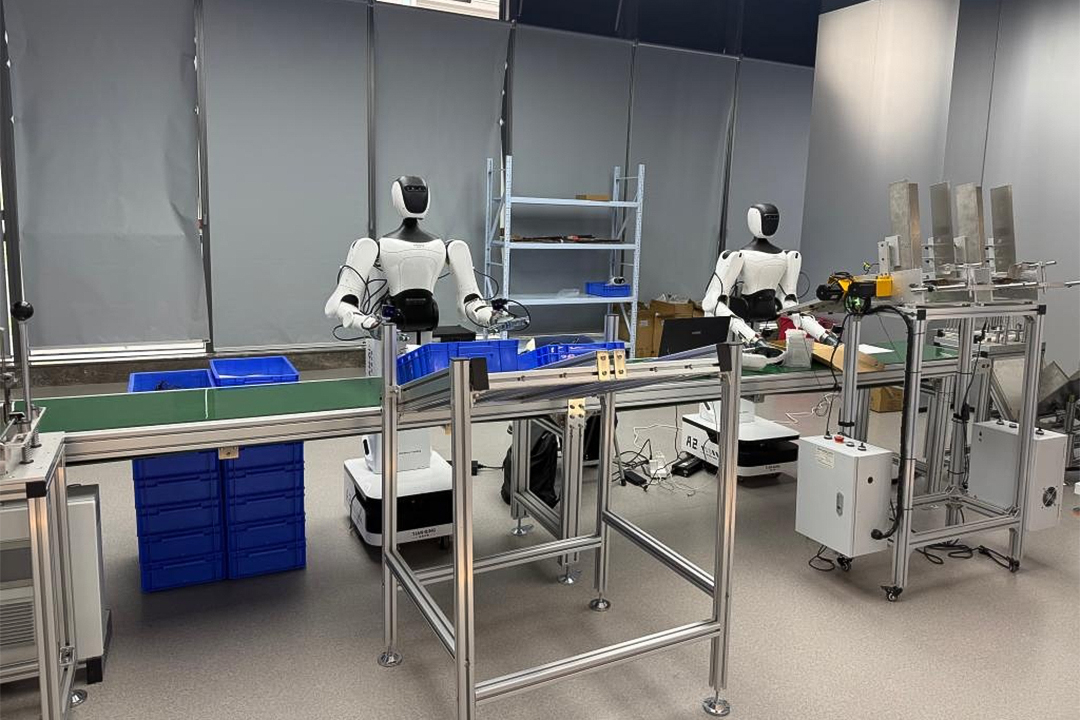
A state mandate to put 10,000 robots into use by 2026 has helped fuel concerns of excessive competition. Photo: Xinhua
A rush of new entrants into China’s humanoid robotics industry is stirring concern among founders and investors that the sector could become overcrowded and face the same self-destructive competition, or “involution,” plaguing the country’s electric vehicle (EV) market.
“The industry is already seeing signs of involution, particularly in semi-humanoid robots and entertainment-oriented robots, where barriers are lower and prices are falling quickly,” said Yao Maoqing, a partner and senior vice president at Shanghai-based AgiBot.
Yao compared the sharp drop in prices with the bruising price wars in China’s auto market, which** erupted** after years of policy support, private investment and a rush of new entrants led to excess capacity and heavy losses.
“The risk is that leading companies use price cuts to squeeze out rivals, hoping to raise prices later after weaker players exit,” Yao told reporters on the sidelines of the Beyond Expo in Macao.
“Rather than trying to identify the winner among hundreds of robotics startups, investors may be better off waiting for the field to thin out,” said Elton Cheung, managing partner at investment firm VMS Group, which represents some of Asia’s wealthiest families.
Chinese companies’ tendency to rush into hot sectors can produce winners, but also many failures, Cheung told Caixin. When a theme becomes fashionable, hundreds of companies can sprout up, backed by investors eager not to miss the next big thing, he said.
China had more than 140 humanoid-robot makers in 2025, which had released more than 330 products, according to data shared at a State Council Information Office press briefing in January.
Industrial push
The concerns come as Beijing is accelerating the industrial deployment of humanoid robots and embodied artificial intelligence (AI). The Ministry of Industry and Information Technology and the State-owned Assets Supervision and Administration Commission on June 9 **issued a joint directive **mandating local governments and state-owned enterprises test and integrate embodied AI into manufacturing, logistics, retail and healthcare. The goal is to put roughly 10,000 humanoid robots into commercial use by the end of 2026.
China’s humanoid robot industry may still be two to three years away from consolidation, said Allen Zhang, founder and CEO of Shanghai-based Matrix Robotics and a former lead engineer at Tesla Inc.
“China still has hundreds of companies working on robot bodies, brains or full-stack systems,” Zhang told Caixin. “Competition has only just started.”

A Matrix Robotics humanoid robot get showcased at the Beyond Expo in Macau. Photo: Beyond Expo
Rapid commercial deployment
As large AI models become more widely available, the next AI opportunity is shifting from pure software to hardware and the ability to connect AI with the physical world. China’s manufacturing strength gives its robot-makers an advantage in fast prototyping, lower component costs and extensive supply chains in motors, sensors, batteries and electronics.
Chinese companies are already leading in developing robot bodies and motion control, helped by domestic supply chains, Yao said. Foreign companies still have advantages in innovation density and access to capital, he said.
Larry Li, founding and managing partner at Silicon Valley-based Amino Capital, said China has a deep manufacturing base that allows companies to iterate quickly and move from prototype to production faster than many overseas rivals. But he also warned that hardware development moves much more slowly than software and that many robotics companies may take longer than investors expect to commercialize.
Matrix Robotics benefits from being based in Shanghai’s Zhangjiang area and connected to the Yangtze River Delta supply chain, which has deep experience in automotive manufacturing, Zhang said. Apart from some edge inference chips, high-end sensors and encoders, most of the company’s materials are domestically sourced.
AgiBot’s Yao sees 2026 as the first year of large-scale humanoid-robot deployment. But deployment doesn’t mean sending a robot into a showroom with a remote control, he said, rather that the machine must operate autonomously, meet customers’ reliability requirements and deliver a return on investment.
“Various types of robots are already beginning to enter factories, including highly automated ‘lights-out’ production environments,” Zhang said, referring to factories with no human workers on the production line.
He added that the stronger near-term demand is in business and service settings such as hotel concierge, hospital reception desks, supermarkets and banks, where tasks are more standardized. Matrix Robotics is partnering with a leading coffee chain in China to deploy its robots in stores later this year.
A wave of commercialization began in late 2025, when a number of robotics manufacturers struck up partnerships in various industrial settings. In December, Spirit AI’s Xiaomo robot began battery-pack testing at a facility operated by Contemporary Amperex Technology Co. Ltd.
In April 2026, AgiBot Robotics livestreamed its robots performing assembly-line tasks at a tablet factory operated by Longcheer Technology Co. Ltd. Later that month, RobotEra partnered with China Post and SF Express to deploy robots in more than 10 logistics centers, with some reaching 85% of human work efficiency.
Consumer robots still out of reach
Despite drawing public attention for dancing, performing acrobatics and running marathons on national television, industry insiders aren’t convinced today’s humanoid robots are ready to enter people’s homes.
“Robots aimed at companionship, health monitoring or elderly care may have better near-term potential, but general-purpose domestic robots are not yet compelling enough for mass consumers,” VMS Group’s Cheung said.
“We’re watching, but we haven’t seen the real demand for a clear use case yet,” he said.
Smaller companion robots and simpler home devices could arrive in large numbers later this year, Matrix Robotics’ Zhang said, while full-size humanoid robots capable of doing meaningful household work, such as hanging clothes or tidying rooms, may take another three to five years to become practical for early adopters.
AgiBot’s Yao said some newcomers may be too eager to jump straight into household robots, even though homes are among the most complex and open-ended environments for machines.
“Some people who have just entered the industry, including some from academia, may have very idealistic views and say they want to build home robots,” Yao said. “But many industries have already proved that you can’t get fat in one bite.”
The industry is also developing amid rising U.S.-China tech tensions. Washington has tightened restrictions on advanced AI chips and increased scrutiny of Chinese technology companies.
For now, the direct impact of chip restrictions on China’s humanoid-robot makers is limited. Current robots do not necessarily require the most advanced AI training chips used by frontier AI model developers, Zhang said. Many of the bottlenecks are still in engineering, cost reduction, reliability and real-world deployment, he said.
Du Zhihang contributed to this story.
Contact reporter Kelsey Cheng (kelseycheng@caixin.com) and editor Jonathan Breen (jonathanbreen@caixin.com)
Technology
In Depth: China’s Humanoid Robot Boom Sparks Fears of Bruising Price Wars
A rush of new entrants into China’s humanoid robotics industry is stirring concern over overcrowding and price wars.