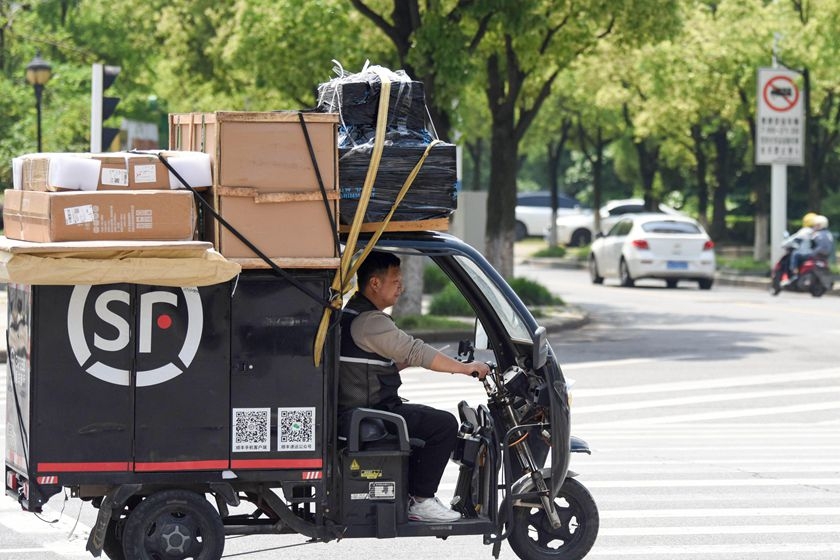
A courier drives along Binhu Road in Yi’an district in Tongling, Anhui province April 30, 2026. Photo: IC Photo
Blue-collar work in China is undergoing a shakeout, as once-fast-growing jobs such as ride-hailing, trucking and livestreaming shrink and workers with higher skills and better customer ratings pull ahead.
China had about 427 million blue-collar workers in 2025, up slightly from 425 million in 2024, but the pace of growth slowed sharply. Domestic helpers, food-delivery riders and parcel couriers — occupations that posted double-digit growth a year earlier — expanded by only 3% to 6%. The number of ride-hailing drivers, truck drivers and livestreamers declined.
The figures point to a labor market whose size and structure are changing.
The findings were released in June 2026 by the China Center for New Employment Forms at Capital University of Economics and Business in its 2025 China Blue-Collar Employment Research Report.
The study, based on 28,450 valid survey samples, multisource data checks and field research, examined changes in China’s blue-collar labor market in 2024 and 2025. It covered maternity nannies, food-delivery riders, truck drivers, parcel couriers, manufacturing workers, ride-hailing drivers, security guards, sanitation workers and cleaners.
The report said China’s blue-collar labor market is being steadily reshaped. Domestic work remained the largest blue-collar occupation in 2025, with 46.8 million workers, up 4% from a year earlier. But that growth rate was more than 24 percentage points lower than the previous year’s 28.57%.
Ride-hailing drivers ranked second, followed by truck drivers and livestreamers, with 37.24 million, 18.13 million and 17.46 million workers, respectively. In 2024, those three groups had grown 26.67%, 8.82% and 19.36% from a year earlier. By 2025, all three had declined. The number of ride-hailing drivers and truck drivers fell 2%, while the livestreamer workforce shrank 3%.
The number of food-delivery riders and parcel couriers stood at 15.9 million and 4.43 million, respectively. Their growth rates fell from 15.38% and 13.16% a year earlier but remained positive, at 6% and 3%.
The changes reflect competitive dynamics in the industries involved. The report said an intense food-delivery battle in 2025 prompted platforms to hire riders aggressively, while ride-hailing drivers faced an oversupply of capacity.
In May, the Shenzhen Municipal Transport Bureau issued a risk warning saying the city’s ride-hailing market was broadly saturated. In April, ride-hailing cars in Shenzhen completed an average of about 13.01 orders a day. “The authorities solemnly remind prospective workers to conduct sufficient research and make rational decisions,” the bureau said.
On pay, the report found that average monthly income for blue-collar workers rose to 6,230 yuan ($919). The income gap with white-collar workers narrowed from a peak of 3,344 yuan in 2013 to 2,250 yuan, and is expected to shrink further to around 2,000 yuan by 2027.
Within the blue-collar workforce, however, clear income tiers have emerged. The high-income group includes maternity nannies, at 10,128 yuan a month; food-delivery riders, at 8,325 yuan; and truck drivers, at 8,279 yuan. All three average more than 8,000 yuan a month.
The middle-income group includes parcel couriers, at 6,360 yuan a month; manufacturing workers, at 6,013 yuan; and ride-hailing drivers, at 6,215 yuan, close to or slightly above the industry average. The basic-income group includes security guards, at 4,592 yuan, and sanitation workers and cleaners, at 3,928 yuan, whose pay is relatively stable but growing more slowly.
From 2023 to 2025, food-delivery riders stood out, with a three-year compound annual growth rate in average monthly income of 10.5%, largely driven by expanding demand for instant services. Maternity nannies, protected by higher professional barriers, recorded a three-year compound annual growth rate of 6.5%. By contrast, ride-hailing drivers’ average monthly income fell at an annual rate of 1.7% over the same period.
The report said the income structure in blue-collar services is shifting from simply rewarding more work to rewarding better work. The basis of competition is moving from physical effort and long hours toward skills and reputation. Platforms have built star-rating systems based on service quality, allowing workers with better service and higher ratings to receive higher unit prices and more high-quality orders.
Some “gold medal” maternity nannies earn more than 25,000 yuan a month, while experienced food-delivery riders can make more than 12,000 yuan, the report said. In effect, higher-skilled workers are earning more.
Even among ride-hailing drivers, the gaps can be substantial. On Didi’s platform in Guangzhou, drivers with a reputation score above 603 earned 26% more a week than those with scores below 563. In Zhengzhou, drivers with a reputation score above 489 earned 30% more a week than those scoring below 415.
The report said the trend shows that labor allocation is returning to real demand. “Overall, the blue-collar employment market is undergoing a deep ‘metabolism’ through internal labor mobility and job iteration,” the report said. “Its development logic is gradually moving away from the traditional demographic dividend and toward tapping the professional value and long-term appeal of the jobs themselves.”
Flexible workers
Many workers in these blue-collar groups are classified as flexible workers. Caixin previously reported that, based on the official figure of “more than 200 million” flexible workers, the group accounted for 27% of China’s total workforce of about 740 million people and nearly 43% of the country’s 470 million urban workers.
The new report said the group is still expanding. Citing a white paper on service-sector flexible employment and innovation released in May by Fudan University and AI flexible-staffing platform Linggong Daka, the report said China had about 280 million flexible workers as of 2025. I
t projected that the number would reach 320 million in 2026, accounting for more than 40% of urban employment and marking a shift from flexible work as a supplement to the labor market to a major pillar.
Compared with traditional blue-collar jobs, the report said, the platform economy can create a more predictable form of “standardized stability” through algorithmic optimization and improved ecosystems. As a result, the new generation of platform-based blue-collar workers is starting to break the stereotype of high turnover, with signs of improving stability.
The average monthly attrition rate for food-delivery riders fell to 22% in 2025 from 27.5% in 2024, while the rate for parcel couriers dropped to 25% from 30.23%, both declines of more than five percentage points. Ride-hailing drivers and truck drivers, affected by fewer jobs and fiercer competition, saw average monthly mobility rates edge up to 25.8% and 20.85%, respectively, but the increases were less than one percentage point from a year earlier. By comparison, manufacturing workers and construction workers had average monthly mobility rates of 17.8% and 21.34%.
County-level markets are also becoming a new growth engine for blue-collar employment, suggesting that more people are choosing to work closer to home. The report found that in 2025, the share of platform-based digital blue-collar workers — including food-delivery riders, parcel couriers and ride-hailing drivers — working across provincial lines continued to fall. The share of ride-hailing drivers working outside their home province declined 6% from 2024, while the share of parcel couriers fell 2.5%.
The report attributed the shift partly to the development of county economies. In county-level instant-retail markets, user numbers, order volumes and transaction values grew significantly faster than in first- and second-tier cities, rising 32%, 35% and 38%, respectively.
County-level work is also becoming more attractive on a cost-benefit basis. Blue-collar workers in county towns can earn 4,000 yuan to 7,000 yuan a month, about 1.5 times the pay of local traditional jobs. After accounting for housing, education, medical care and other living costs, an income of 5,000 yuan in a county town provides a standard of living equivalent to more than 12,000 yuan in a first-tier city, the report said. County-level blue-collar workers also have more time to spend with their families.
Still, the report said flexible blue-collar workers face a structural dilemma: their basic survival needs are largely protected, but their development prospects remain limited. Participation in basic medical insurance has reached 91.5%, and occupational-injury coverage stands at 86.2%, meaning baseline protections have largely been built. But confidence in retirement planning, at 42.3%, and career-advancement opportunities, at 54.8%, remain clear weak spots.
“This reveals a deeper contradiction in the current protection system: Flexible workers may temporarily have a sense of security, but they lack a sense of control over the future,” the report said. “The leap from ‘having work’ to ‘having prospects’ remains an urgent problem to solve.”
Traditional blue-collar employment
Beyond the platform-based new blue-collar workforce, many blue-collar workers remain in traditional employment arrangements. Their conditions, the report said, deserve continued attention.
The National Bureau of Statistics’ 2025 Migrant Worker Monitoring Survey Report showed that China had 301 million migrant workers in 2025. The share employed in the secondary sector fell to 44.5%, a record low.
Within that category, the share of migrant workers in manufacturing rose for a fourth consecutive year, reaching 28.2% in 2025, up 0.3 percentage point from a year earlier. The share working in construction has fallen continuously since 2022, reaching just 13.8% in 2025, matching 2008 as the lowest level since data became available. Even so, the two sectors still employed 84.92 million and 41.56 million migrant workers, respectively.
In pay, migrant workers earned an average of 5,075 yuan a month in 2025, up 2.3% from a year earlier. The growth rate slowed by 1.5 percentage points.
By sector, construction migrant workers earned the most, at 5,880 yuan a month, up 2.4% from a year earlier. Manufacturing migrant workers earned 5,126 yuan a month, up 3%. In wholesale and retail, lodging and catering — sectors where the share of migrant workers has increased significantly in recent years — average monthly pay remained low, at less than 4,500 yuan, with growth of just 0.5% and 1.6%, respectively.
The report also said traditional blue-collar employment continues to lag platform work in income, working hours and protections.
Its survey found that traditional employment models often involve longer wage-settlement cycles and higher risk of wage arrears. In construction, the average settlement cycle is 45 to 60 days; in manufacturing, it is 30 to 45 days. Among surveyed construction workers, 73% said they had experienced wage arrears. Another 65% of workers said they were unable to clearly connect their daily workload with their income.
On time, traditional jobs involve very long hours. Manufacturing workers averaged 58.3 hours a week, and 42% worked more than the legal standard of 44 hours. Among respondents with caregiving responsibilities, 83% said traditional working hours made it difficult to meet those needs, while 76% of construction workers said they were unable to reunite regularly with their families.
On protections, the report found that only 32% of traditional blue-collar workers had work-injury insurance. Among construction workers, the participation rate was just 28%, far below the level for urban employees. In 71% of occupational-injury cases, workers had to shoulder most medical costs themselves. Among respondents, 82% said they first tried to “tough it out” when dealing with minor illnesses, making delayed medical care common.
A front-line worker at a large domestic electronics manufacturer told Caixin that the worker’s factory operates on two shifts. Taking the day shift as an example, workers spend about 11 hours a day in the factory, from 7:30 a.m. to 6:30 p.m., including meal breaks. They usually work another two hours of overtime on top of that.
“Our main source of pay is overtime, so we usually volunteer for it,” the worker said. The employee has worked at the company for more than a decade and currently has a base salary of about 2,450 yuan a month. Overtime pay on weekdays and weekends is 1.5 times and two times the base-pay standard, respectively. Only by working a full load of overtime can monthly pay reach about 4,000 yuan to 5,000 yuan.
Platform-based blue-collar services have become a transition path for many traditional blue-collar workers. But as overall growth in the blue-collar labor market slows and skills and reputation matter more, the threshold for entering those jobs is rising. Income growth and career transitions for traditional blue-collar workers will depend in part on more skills training and public employment services.