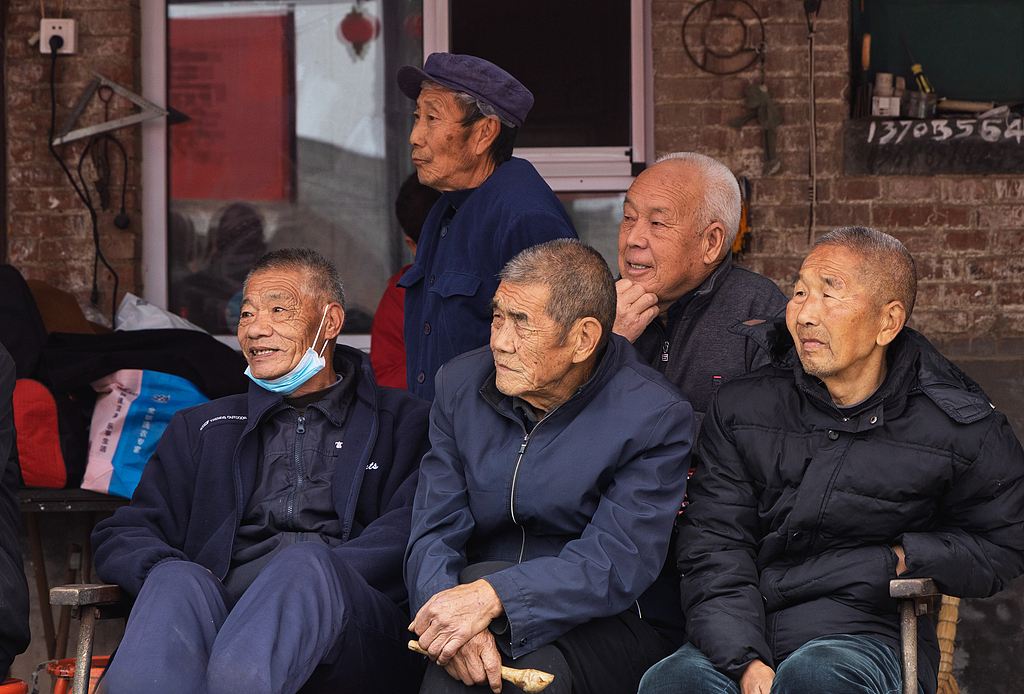
Several elderly residents sit in a doorway in Wucheng village in Jincheng, Shanxi province, on Oct. 29, 2025. Photo: VCG
Facing a rapidly aging population and the hollowing out of rural households, China is formalizing a novel solution for elderly care: asking younger seniors to look after their older neighbors.
Eleven government departments, including the Ministry of Civil Affairs, recently issued guidelines to promote “mutual elderly care.” The plan mandates that by 2030, at least 70% of urban and rural communities will have facilities supporting this mutual-aid model. By 2035, the government wants a highly organized system that fulfills seniors’ needs for daily check-ins, social engagement, and emotional support.
Mutual elderly care relies on neighborhood or community residents helping one another, specifically with younger, healthier seniors providing voluntary, nonprofit assistance to older ones. The concept originated in 2008 with the rural mutual-aid happiness home model in Feixiang, Hebei province. Under that program, abandoned elementary schools were renovated to allow seniors to move in for free and care for one another, while their children continued to cover the costs of food, clothing, and medical care.
Compared with urban areas, rural seniors face a more severe isolation crisis as traditional family-based care structures break down. According to 2022 data from the Ministry of Civil Affairs, empty nesters account for more than half of China’s elderly population, a figure that exceeds 70% in some rural villages. Meanwhile, rural nursing homes are rare due to a lack of professional staff, high transportation costs, and a massive supply shortfall.
The state has steadily pushed the mutual-care concept. China’s State Council proposed exploring new rural mutual-care models as early as 2011, and the current 14th Five-Year Plan explicitly calls for building a rural mutual-care network anchored by village drop-in spots and neighborhood centers.
To execute the plan, the new guidelines designate village officials and community leaders as the backbone of the initiative. Younger seniors will serve as the primary workforce, providing assistance with meals, cleaning, transportation, medical needs, emergencies, rehabilitation, and disease prevention. Special-needs seniors, or those living in remote areas without public services, will be encouraged to relocate to centralized communities that meet building and fire safety standards.
For infrastructure, the government is encouraging the renovation of small supermarkets, convenience stores, and vacant houses for accessibility. Existing senior care institutions will also be urged to open their facilities and establish service outposts.
Sustainability and funding struggles
The long-term viability of rural mutual care faces mounting challenges. The original Feixiang model — once promoted as a national template — has struggled with ambiguous legal status, unstable funding, and a lack of inclusivity. Many centers, for instance, turn away seniors with dementia or severe disabilities.
Funding remains a primary hurdle. A report by the China National Committee on Ageing noted that current funding relies on a mix of local governments, foundations, and village collectives. With local government budgets broadly strained, state disbursements are unstable, leaving many mutual-care programs dependent on external social organizations.
However, charities remain largely absent from the countryside. One philanthropic sector insider said foundations overwhelmingly favor children’s projects. The limited funds directed at seniors typically flow toward urban community services and “smart” elder care, rarely reaching grassroots rural areas. Without reliable revenue streams, these rural programs remain heavily dependent on the government.
In response, the new guidelines propose a diversified funding model reliant on government subsidies, collective contributions, family payments, and social donations. Local governments, for instance, are encouraged to allocate a portion of state welfare lottery funds or collective rural economic earnings to support these programs.
In Fulemiao village in Langzhong, Sichuan province, city and county departments provide construction and operational subsidies for new or remodeled mutual-care centers. The village uses a portion of its collective economic revenue to fund elder care, while simultaneously developing agricultural processing, specialty farming, and handicraft projects to boost center incomes.
Yet, village officials in western mountainous regions told Caixin that mutual care is only viable in wealthy areas with flat terrain. In their own villages, which lack collective dividends and see children return home perhaps once a year, most seniors still rely entirely on themselves.
Banking time for the future
The willingness of younger seniors to participate is crucial. Rather than receiving direct pay, caregivers are often compensated through a “time bank” system, earning credits they can redeem for care when they grow older. The guidelines state that mutual-care hours can be exchanged for basic elder services, social practice credits, or even transferred to direct relatives.
In Chibi, Hubei province, the Shuguang Cooperative operates a nursing home using a mixed-payment model. The cost of care is roughly 6,000 yuan ($833) per person annually. Farmers can lease their land to the cooperative to offset an average of 2,000 yuan. The remaining 4,000 yuan shortfall is covered through paid labor. Healthy seniors can raise pigs, tend chickens, grow vegetables, or care for neighbors with limited mobility. Their work is calculated in points, settling their monthly nursing home fees alongside state pensions and farming subsidies.
Zhong Tiehua, secretary-general of the Shanghai Changyi Public Welfare Foundation, noted that rural mutual care differs from government-led urban models because of its autonomous nature within village communities.
“For villages, healthy seniors are the largest local human resource,” Zhong said. “First, mobilize the service potential of younger and middle-aged seniors. Later, when they have needs themselves, their status transforms into beneficiaries.”
Wang Hui, a public administration professor at Chongqing University, wrote that local governments should establish dedicated funds or minimum budget ratios for mutual care. Wang advised offering tiered subsidies based on performance and participation, as well as utility waivers for mutual-care stations.
Furthermore, Wang suggested linking elder care with agricultural production. Programs should encourage seniors to exchange farming techniques and labor, and connect elder care organizations with agricultural cooperatives to create age-appropriate jobs like sorting, packaging, and light harvesting.